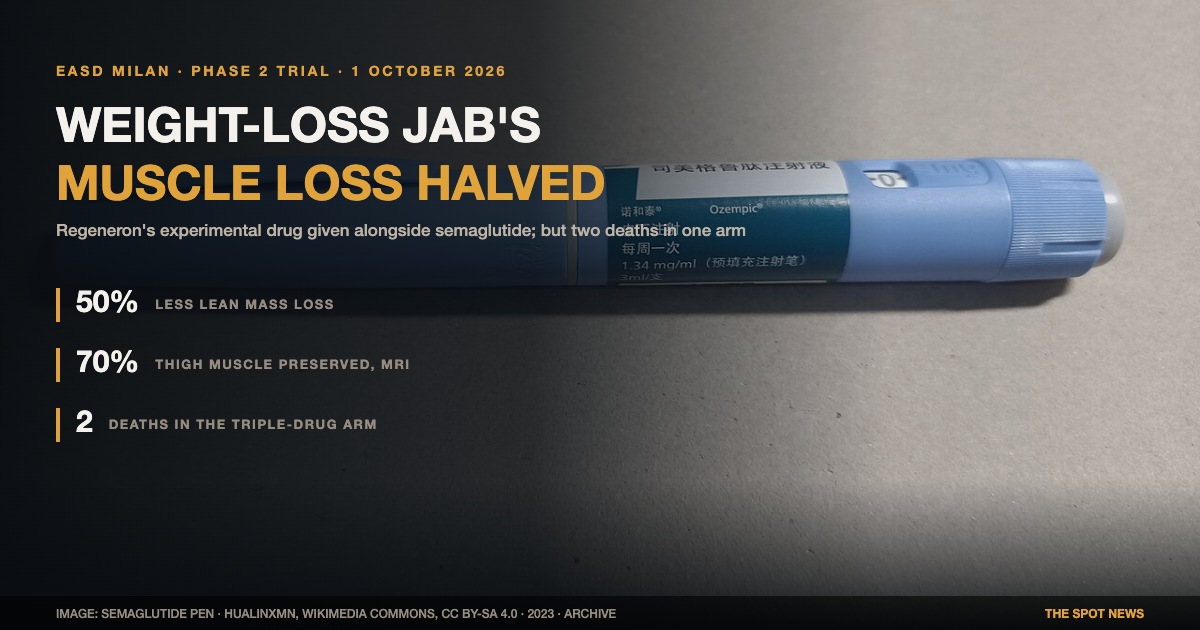
One of the biggest problems for people losing weight quickly on GLP-1 drugs such as semaglutide is that a large share of what they lose is muscle rather than fat. According to phase 2 data presented on 1 October at the European Association for the Study of Diabetes (EASD) congress in Milan, US drugmaker Regeneron says its experimental drug trevogrumab, given alongside Novo Nordisk’s semaglutide, reduced lean mass loss by 50% compared with semaglutide alone. The drug blocks myostatin, a protein that limits muscle growth, and belongs to a different class from GLP-1 drugs.
The trial, called COURAGE, was run in two parts in nearly 1,000 participants aged 18 to 65 with a body mass index of 30 or more. Over the first 26 weeks, patients on semaglutide alone lost 6.7% of their lean mass; with 75 mg of trevogrumab added the loss was 3.3%, and with 25 mg it was 4.7%. In an MRI substudy measuring thigh muscle, the 75 mg dose prevented more than 70% of the muscle loss associated with semaglutide at 52 weeks. According to Regeneron, when patients stopped semaglutide but continued trevogrumab, their muscle mass returned to its pre-study level, suggesting the drug could help rebuild lost muscle. The company chose a once-weekly 75 mg dose for further studies and plans another phase 2 trial in patients over 65.
The safety picture is mixed. Regeneron says the combination of trevogrumab and semaglutide had a side-effect profile similar to semaglutide alone, with no unexpected adverse effects. But in the arm combining a high dose of trevogrumab with the company’s second drug, garetosmab, two participants died during the first 26 weeks, and that arm had a high rate of adverse effects including muscle spasms. The company said it would not take the triple combination forward. Whether the deaths were causally linked to the drugs was not disclosed in the sources.
The findings are a new step in the debate about the quality rather than the quantity of weight loss. With semaglutide alone, roughly 35% of the weight lost is reported to come from muscle tissue. Eli Lilly, which tried a similar approach, halted a trial of bimagrumab, a drug targeting the myostatin pathway. Trevogrumab is not an approved drug, the results come from a company-sponsored phase 2 trial, and although the study has been accepted by The Lancet, the peer-reviewed full paper has not yet been published. Semaglutide is widely used in Turkey too; this report is not treatment advice.
The 50% reduction, nearly 1,000 participants, ages 18 to 65, the EASD Milan presentation, 70% preservation on MRI, 6.7% loss on semaglutide alone, 4.7% at 25 mg and the return of muscle mass: Reuters (via Emirates 24/7), 1 October 2026; EMJ, 2 October 2026. The 3.3% loss at 75 mg, the planned trial in over-65s, the two deaths in the triple arm, the muscle spasms and the decision to drop the combination: Rallies (citing Reuters), 30 September 2026. The COURAGE name, the two-part design, BMI of 30 or more and the 35% muscle share of weight lost on semaglutide alone: Patient Care Online, 1 October 2026. The myostatin mechanism, the Lancet acceptance and the DXA and MRI measurements: Medical Xpress, 30 September 2026. Regeneron's official release and the 72.7% and 68.9% preservation figures: GlobeNewswire, 1 October 2026. Lilly halting its bimagrumab trial: Wikipedia, bimagrumab.
The results come from a company-sponsored phase 2 trial; no phase 3 has been run and the drug is not approved. Although accepted by The Lancet, the peer-reviewed paper has not yet been published. Whether the two deaths in the triple arm were causally related to the drugs is not disclosed in the sources. This report is not treatment advice.
The cause of the deaths, the price of trevogrumab and any approval timeline, and when a phase 3 trial will begin have not been disclosed.
Leave a comment