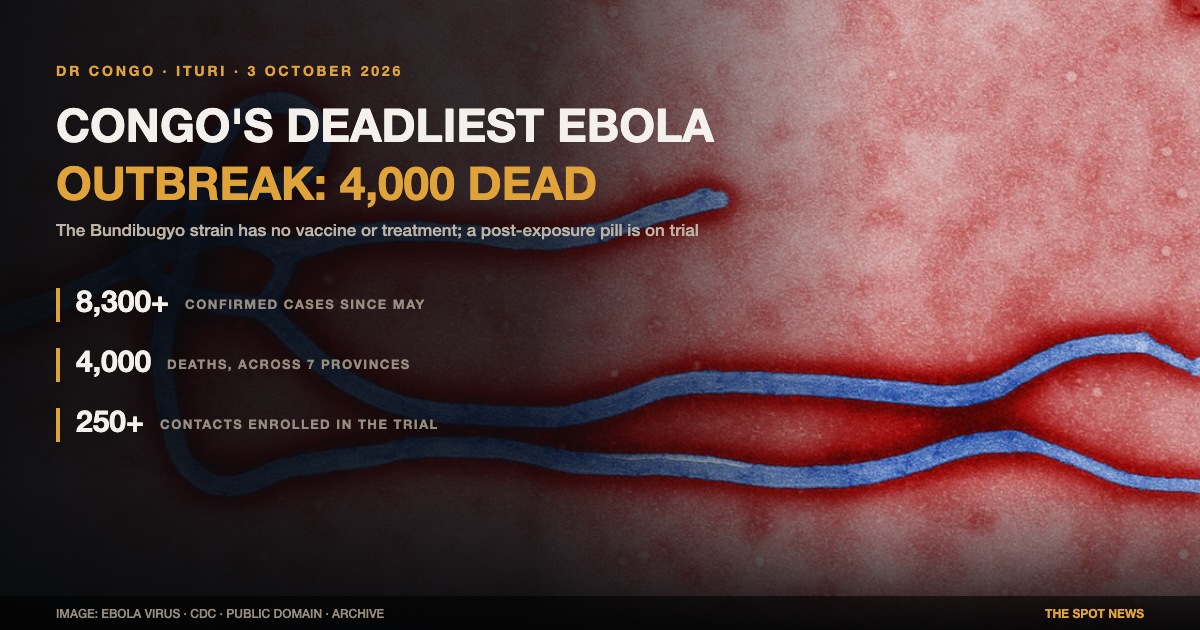
The Ebola outbreak declared in mid-May in eastern Democratic Republic of Congo has become the deadliest in the country’s history. According to an AP report from Rwampara in Ituri province on 3 October, at least 8,300 confirmed cases and 4,000 deaths have been recorded; the disease has spread to seven provinces and, authorities say, continues to outpace efforts to track and slow it. The outbreak is caused by Bundibugyo virus, discovered in Uganda in 2007, and is the largest Bundibugyo outbreak ever documented; the strain has no approved vaccine or treatment.
At the epicentre in Ituri, a source of hope is under trial. In the EBO-PEP study coordinated by the medical charity ALIMA, people over 12 who have had contact with a confirmed case within the past five days but show no symptoms are given Gilead’s experimental antiviral pill obeldesivir. The trial began in July and has enrolled more than 250 participants; it aims for nearly 1,000, half of whom will receive a placebo. The approach is called post-exposure prophylaxis. According to ALIMA research coordinator Dr Guilavogui Jean Paul Yassa, it differs from a vaccine, which may take days or weeks to provide protection, and from curative treatment, because it is intended for people not yet showing symptoms.
Participants are monitored in person every day for 21 days, with a final phone call after 42 days. If symptoms appear they immediately receive supportive treatment, which has been shown to help when caught early. One participant told AP she enrolled in August after her husband tested positive and that no one in her family has developed symptoms; another said two family members had caught Ebola and one had died. Participants asked for anonymity given the sensitivity of the outbreak. The trial’s partners include Congo’s National Institute of Biomedical Research and the French institute ANRS Emerging Infectious Diseases.
This is Congo’s 17th Ebola outbreak and began only five months after the previous one ended; the earliest known suspected case was a man who fell ill on 24 April and died three days later. On 16 May the World Health Organization announced eight confirmed cases in Ituri, one in Kinshasa and two in Kampala, Uganda. The response is being run in a highly unstable region affected by the Congo-Rwanda conflict; mobile laboratories in Butembo are testing rapidly. If the pill proves effective, it could protect the most exposed groups, such as health workers and patients’ relatives, and break the chain of infection; trial results have not yet been released.
The 8,300 cases and 4,000 deaths, the May declaration, seven provinces, outpacing tracking, more than 250 participants, obeldesivir, the target of nearly 1,000, the placebo, the five-day and age-12 criteria, the participants' accounts and anonymity: AP (via Arab News, PBS, Medical Xpress and KRMG), 3 October 2026. The July start, no approved vaccine or treatment, Yassa's remarks, the 21 and 42 day monitoring, Basara's account, supportive treatment and the trial partners: PBS NewsHour and KRMG (AP), 3 October 2026. The mobile laboratory in Butembo: Arab News (AP photo). Bundibugyo's 2007 discovery in Uganda and the largest Bundibugyo outbreak: Field Investigation paper, PMC, 2026. The 17th outbreak, five months after the previous one, the 24 April first case, the WHO announcement of 16 May and the Congo-Rwanda conflict: Wikipedia, 2026 Central Africa Ebola epidemic. The 15 May declaration in Congo and Uganda: Emerging Microbes and Infections paper, September 2026.
Case and death figures are official counts relayed by AP and are changing rapidly. Trial results have not been released; whether the pill works is unknown. Individual participants' accounts say nothing about the trial's outcome.
When the trial will conclude, the status of vaccine studies, current data on spread beyond Congo and the scale of international aid are not covered here.
Leave a comment