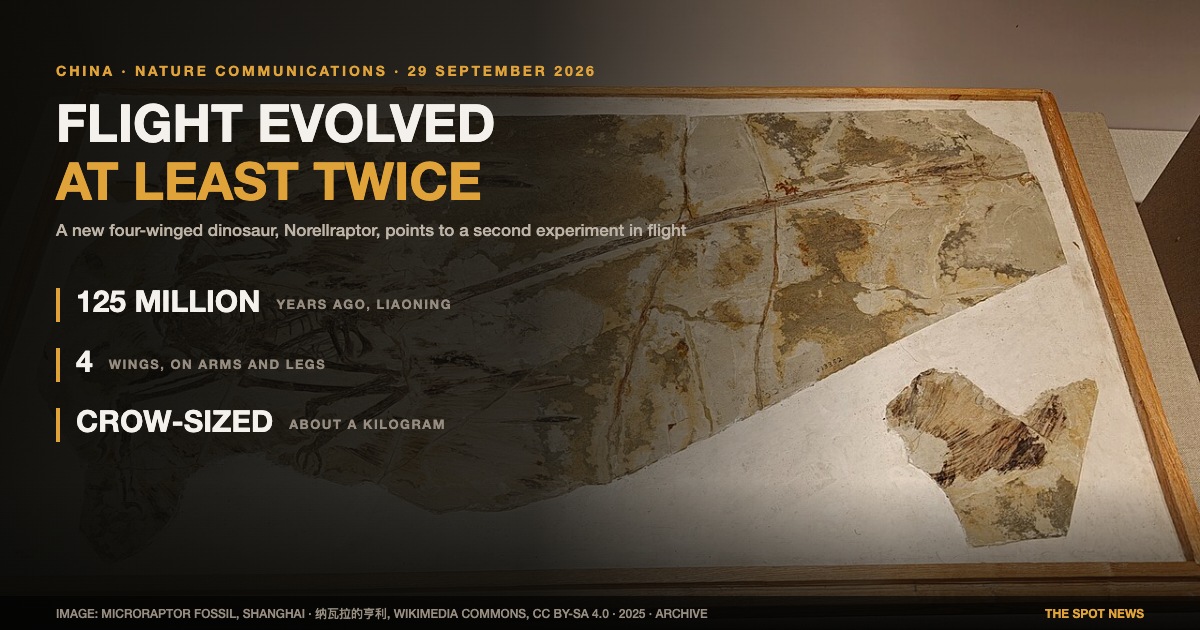
A 125-million-year-old dinosaur fossil from Liaoning province in north-eastern China provides strong evidence that flight arose independently at least twice in evolutionary history. According to a study published on 29 September in Nature Communications, the new species, named Norellraptor barsboldi, was a four-winged dromaeosaurid with long flight feathers on both its arms and legs. The fossil preserves its feathers and the soft tissues of its spine in exceptional detail.
Michael Pittman, a palaeontologist at the University of Hong Kong who was part of the team, said Norellraptor was not a close relative of the lineage that includes birds, yet it carried bird-like flight features. According to Pittman, this shows that dinosaurs experimented with flight more than once. The team placed the species in the same group as its four-winged relative Microraptor and argues that this group underwent its own evolution of flight, separate from the line leading to birds.
The structure of the wings and the animal’s weight of about a kilogram allowed the researchers to estimate its flight capability. Norellraptor, about the size of an American crow, was a flapping flyer rather than a mere glider, they say. The finding strengthens the case that flight developed in parallel several times, against the widespread view that it emerged once among feathered dinosaurs and was passed on to birds.
The species honours Mark Norell, the American Museum of Natural History palaeontologist who died in 2025, and Mongolian palaeontologist Rinchen Barsbold. Liaoning’s fossil beds, known as the Jehol biota, have been the most important source of feathered dinosaurs since the 1990s; Microraptor was found in the same region in 2003.
The Liaoning find, 125 million years, publication in Nature Communications on 29 September 2026, the four wings, Pittman's 'more than once' remark and the distance from birds: Nature news, 2 October 2026; Phys.org, 29 September 2026. The American crow size, roughly a kilogram and the flapping flight estimate: Live Science, 30 September 2026; New Scientist, 29 September 2026. The naming after Norell and Barsbold: University of Hong Kong release (EurekAlert), 29 September 2026. The soft tissue preservation and placement with Microraptor: Science News and SciTechDaily, 30 September 2026. The Jehol biota and Microraptor's 2003 discovery: Wikipedia, Microraptor.
The conclusion that flight evolved at least twice is the study's interpretation; the flight capability of dromaeosaurids is debated among palaeontologists, and some argue these animals only glided. The flight estimates rest on models derived from the fossil.
When the fossil was found, which institution excavated it and where it will be displayed are not covered here.
Leave a comment