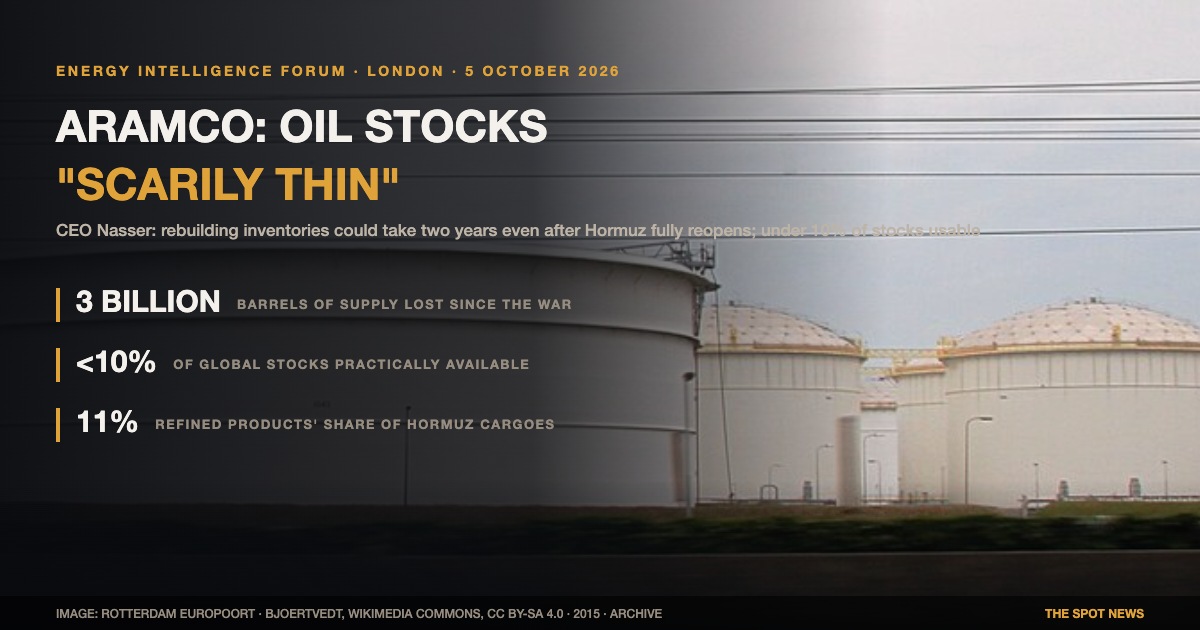
Amin Nasser, president and chief executive of Saudi Aramco, the world’s largest oil company, told the Energy Intelligence Forum in London on Monday 5 October that global oil inventories have fallen to scarily thin levels, and warned that rebuilding them could take up to two years even after the Strait of Hormuz fully reopens. Until Hormuz fully reopens and confidence returns, he said, the crude reality is that pressure at both ends of the barrel will intensify; even then, replenishing inventories while meeting demand could take up to two years.
Nasser’s figures underline the scale of the problem: nearly 3 billion barrels of oil supply have been lost since the US-Iran war began; more than 1 billion barrels have been drawn from inventories to offset the losses, most of it from onshore commercial stocks, which he called the last major tool in the box. The roughly 6 billion barrels remaining in storage are not practically available, he said, leaving less than 10% of world inventories usable. The system is already straining, Nasser said, estimating that the world needs an extra 2 million barrels a day over 18 months to rebuild stocks. While the squeeze on crude is serious, refined fuel prices have risen even more sharply.
Nasser said the release of up to 100 million barrels of emergency oil and diesel stocks agreed by major economies last week would provide temporary relief but would not resolve the imbalance. According to Kpler data cited by the Wall Street Journal, crude flows through Hormuz have recovered to about 76% of prewar levels, but refined products make up only about 11% of cargoes, as damaged Gulf refineries keep diesel in short supply; Nasser noted that halted Chinese fuel exports are also supporting diesel and petrol margins. Some analysts counter that record production and alternative routes could speed the rebuild once Hormuz reopens, suggesting the two-year forecast may be too pessimistic; oil prices dipped slightly on Monday.
On Aramco itself, Nasser said the company had maintained supplies through the conflict by using international storage and rapidly repairing damaged infrastructure, had increased shipments from its Ras Tanura terminal and had restored flows on its East-West pipeline to about 80% of capacity after last month’s attack forced a shutdown; more than 90% of the materials used in repairs came from its local supply chain. The company is studying additional crude export routes and overseas storage. Calling oil and gas the lifeblood of modern civilisation, Nasser urged greater international coordination. Turkey sources much of its energy imports from the region, and the diesel shortage feeds directly into Turkish fuel prices.
'Scarily thin', two years, the 100 million barrels as temporary relief, Ras Tanura and the East-West pipeline at 80%: Investing.com, 5 October 2026. The 'both ends of the barrel' quote, the 90% local supply chain and the search for additional routes: Arab News and Arabian Business, 5 and 6 October 2026. The 3 billion barrels lost, 6 billion 'not practically available', commercial inventories and the warning of worsening: CNBC (citing Reuters), 5 October 2026. The 1 billion barrels drawn, under 10%, 2 million barrels a day over 18 months, Kpler's 76% and 11% (via WSJ) and Chinese exports: investingLive, 6 October 2026. 'Last major tool in the box' and refined prices rising faster: Business Standard, 5 October 2026. 'The system is already straining' and the analysts' counterview: Gokhshtein, 5 October 2026. The 11 September pipeline shutdown: Wikipedia, East-West Crude Oil Pipeline.
The figures are the Aramco chief executive's own estimates, without independent verification, and some analysts consider them pessimistic. The 76% and 11% data are Kpler's, relayed via the WSJ and investingLive. The statement on Turkey's energy imports is general knowledge.
Aramco's current output, when Hormuz will fully reopen and the effect on Turkey are not covered here.
Leave a comment