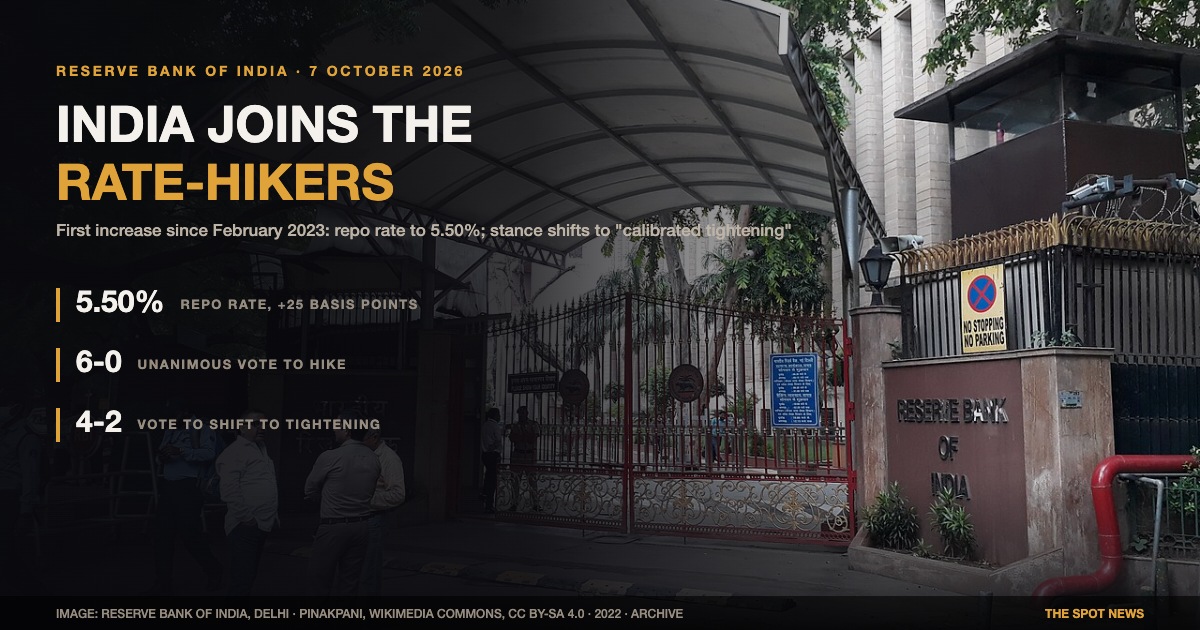
The Reserve Bank of India (RBI) raised its benchmark repo rate by 25 basis points to 5.50% on Wednesday 7 October. According to Reuters, it is the bank’s first rate hike since February 2023, taken in response to a less favourable inflation outlook and heightened geopolitical risks. The RBI had held the rate at 5.25% at its August meeting. The hike was unanimous on the six-member monetary policy committee, which also voted 4-2 to shift its policy stance from neutral to calibrated tightening, indicating that most members see scope for further increases in borrowing costs.
Governor Sanjay Malhotra said the timing and extent of any additional increases would depend on how inflation and economic growth evolve. The decision matched expectations: economists had anticipated a 25 basis point move as headline consumer inflation reached 4.82% in August and stayed above the central bank’s target range for several months, with energy costs high. Higher oil prices raise the cost of energy imports, which in turn pressures the rupee. Growth remains resilient: a World Bank report this week projects South Asia’s economy growing 6.9% in 2026, while warning that energy shocks and extreme weather could threaten the outlook.
The move comes as energy-driven inflation pushes central banks worldwide towards tightening. The US Federal Reserve raised rates to 3.75-4.00% on 16 September, the European Central Bank has hiked twice this year, and the Bank of Japan lifted its rate in September to 1.25%, a 31-year high, signalling this week that more would follow. With India’s hike, the wave has reached the world’s most populous country and Asia’s third-largest economy. In its policy statement the RBI listed elevated valuations of AI-related assets globally as a key downside risk to the world economic outlook, alongside geopolitical tensions, tighter financial conditions and high public debt.
The increase means higher loan costs for Indian borrowers, as a large share of commercial bank lending is linked to the repo rate. The RBI’s last tightening cycle began with a surprise off-cycle hike in May 2022 and ended at 6.50% in February 2023; the bank cut rates by a total of 100 basis points in the first half of 2025. For emerging markets such as Turkey, India’s shift to tightening reshapes the interest rate differentials that steer global capital flows.
The 25 basis point hike to 5.50%, the first since February 2023, the 'less favourable inflation outlook and geopolitical risks', the unanimous vote, the 4-2 shift to calibrated tightening, Malhotra's remarks and 5.25% in August: Investing.com (Reuters), 7 October 2026. The 4.82% August inflation, above target, the oil and rupee pressure and the effect on borrowers: Whalesbook, 6 October 2026. The AI asset valuations, geopolitical tensions, financial conditions and public debt risks: Daily Current Affairs (RBI statement), 7 October 2026. The World Bank's 6.9% South Asia projection: Sunday Guardian digest, 7 October 2026. The May 2022 surprise hike, 6.50% in February 2023 and the 100 basis points of cuts in 2025: Business Standard archive. The Fed, ECB and BOJ hikes: our earlier reports (CNBC, Eurostat, Reuters), October 2026.
The RBI's full policy statement was not reviewed; Reuters and secondary reports were used. The August inflation figure rests on a single source (Whalesbook). The closing sentence on Turkey is a general assessment.
The RBI's updated inflation and growth forecasts, the rupee's reaction and the date of the next meeting are not covered here.
Leave a comment