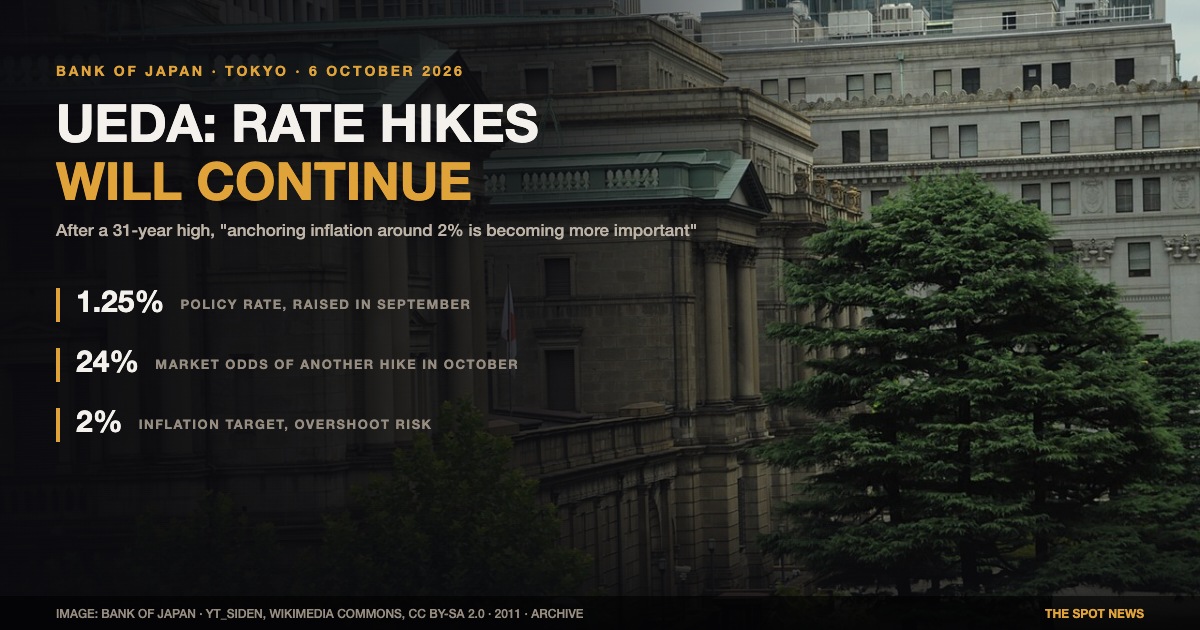
Bank of Japan governor Kazuo Ueda said on Tuesday 6 October, in a speech to the National Securities Convention in Tokyo, that it is becoming more important to anchor underlying inflation around the central bank’s 2% target, signalling, according to Reuters, readiness to keep raising interest rates to blunt the risk of too-high inflation. It was his first major public address since the BOJ lifted its policy rate from 1.00% to 1.25% in September, the highest level in about 31 years.
According to Ueda, economic and price developments are moving in line with the BOJ’s baseline scenario: the economy is recovering moderately albeit with some weaknesses, business sentiment is favourable and long-term inflation expectations are rising. Financial conditions remain accommodative and continue to underpin economic activity even after last month’s hike, he said, adding that the bank will continue to raise borrowing costs to adjust the level of monetary support. The pace and timing of future adjustments would be decided on the likelihood of the baseline projections materialising, as well as risks.
Ueda listed the sources of overshoot risk: price pressures from the US-Israeli war on Iran, strong AI-related demand and the weak yen. Deputy governor Shinichi Uchida recently described artificial intelligence as a positive demand shock adding to price pressures. The BOJ took September’s decision by a 7-2 vote, saying underlying inflation is likely to reach a level consistent with the target from the second half of fiscal 2026 through fiscal 2027 and that yen depreciation is likely to push prices up.
Markets price roughly a 24% chance of a second consecutive hike at the BOJ’s meeting on 29 and 30 October; September’s summary of opinions included a view that there is no need to rush. Analysts read Ueda’s description of conditions as still accommodative, alongside his commitment to keep raising rates, as a yen-supportive narrative. Japanese rate rises can affect capital flows to emerging markets including Turkey through the unwinding of yen carry trades.
The 6 October 2026 speech, the 'becoming more important' wording, the readiness to keep hiking, the baseline scenario, rising long-term inflation expectations, the Iran war, AI demand and weak yen risks, the 'remain accommodative' quote and continuing to raise borrowing costs: Reuters (via Investing.com), 6 October 2026. The National Securities Convention, the September hike to 1.25%, the first major address, the 24% probability and the 'no need to rush' view: investingLive and Orbex, 6 October 2026. 'Recovering moderately with some weaknesses', business sentiment and the pace and timing remark: ForexFactory live feed, 6 October 2026. The 7-2 vote, the fiscal 2026-2027 projection, the yen effect and the 31-year high: FXStreet, September 2026. Uchida's 'positive demand shock': investingLive, 6 October 2026. The 29-30 October meeting: general calendar information.
Ueda's remarks rest on news accounts; the full text was not reviewed. The 24% probability is market pricing. The statement on Turkey is a general assessment; the sources contain no Turkey data.
The yen's level after the speech, the BOJ's current inflation forecasts and the Japanese government's stance on rate hikes are not covered here.
Leave a comment