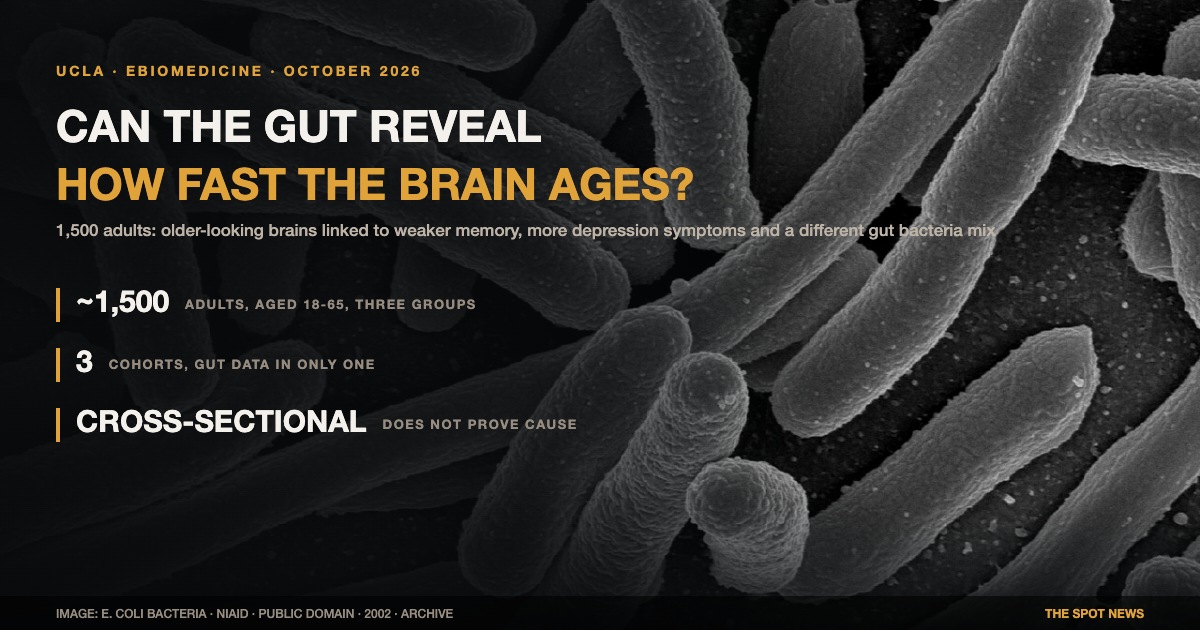
A new study by UCLA Health researchers published in the journal eBioMedicine has found a connection between how quickly the brain ages and the bacteria and chemical byproducts in the gut. The researchers analysed brain scans from nearly 1,500 mostly healthy adults aged 18 to 65 across three separate groups, using a method that measures how different regions of the brain communicate with one another at rest, and from those patterns estimated a brain age for each participant.
The difference between the estimated brain age and a person’s actual age was termed the Brain Aging Index; when the estimate exceeded the actual age, the researchers took it as a sign of faster apparent brain ageing. An older-looking brain does not mean someone has dementia, but earlier research had linked accelerated brain ageing to problems with memory, thinking and mood. In this study too, participants with higher scores performed less well on assessments of working memory and executive function and reported more symptoms of depression; the brain patterns pointed to regions tied to memory and self-referential thought.
The study’s most intriguing finding came from the gut microbiome analysis: individuals with a higher Brain Aging Index had distinct gut microbial signatures and several metabolic byproducts, including specific fatty molecules, a cholesterol-related compound and lower levels of the hormone estetrol. Researcher Zhao told Inc. that what surprised the team most was that differences in brain ageing were linked not just to individual gut microbes but to a broader biological signature spanning the microbiome and metabolites. According to senior author Dr Arpana Church, co-director of UCLA Health’s Goodman-Luskin Microbiome Center, brain ageing does not suddenly begin in old age; the biological signals may be detectable decades earlier.
The researchers are explicit about the limits. The study is cross-sectional, describing associations between indicators rather than proving that gut bacteria cause faster brain ageing; the detailed gut analysis was available in only one of the three groups, and the study tested no intervention. In Zhao’s words, the team cannot conclude from these data that changing the microbiome will slow brain ageing. The findings add to a rapidly growing body of evidence that the gut and brain are closely connected through the gut-brain axis, and open the door to exploring whether targeting gut health could one day support healthier brain ageing. This report is not medical advice.
eBioMedicine, nearly 1,500 adults, three groups, the resting-state communication method, the Brain Aging Index, the memory and mood link and the 'targeting gut health' line: Newswise (UCLA Health release). Church's 'decades earlier' remark, working memory and executive function, depression symptoms, the paper title and the 'does not prove cause' note: Digital Journal, 4 October 2026. Ages 18 to 65, mostly healthy, Zhao's 'biological signature' and 'not designed to test interventions' remarks, the memory and self-referential regions: Inc., 6 October 2026. The fatty molecules, cholesterol compound, estetrol and cross-sectional design: UA.News (citing ScienceDaily), 4 October 2026. Gut analysis in only one group and 'older brain is not dementia': Knowridge, September 2026. ScienceDaily summary, 1 October 2026.
The study is cross-sectional and does not establish causation. Gut data were available in only one of three cohorts. The full paper was not reviewed; the UCLA release and news accounts were used. The publication date varies between late September and early October across sources.
The size of the group with gut analysis, which bacterial species were identified and the study's funding are not covered here.
Leave a comment