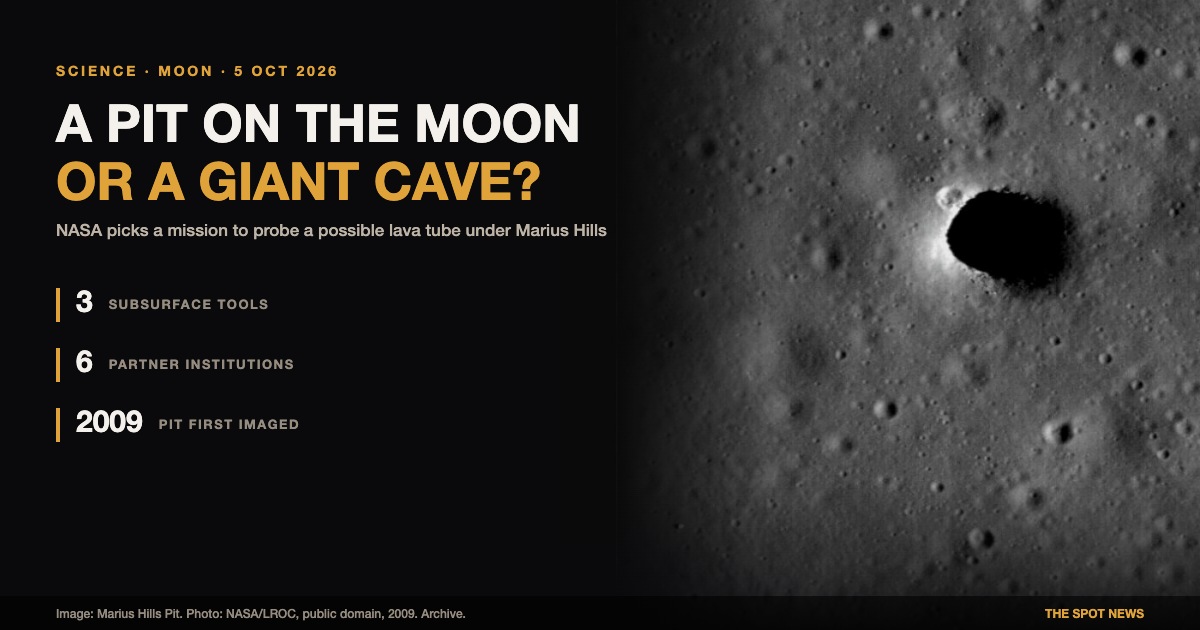
NASA has selected a project to investigate whether a large cave or lava tube extends beneath a big pit on the Moon’s surface. Led by the Planetary Science Institute (PSI), the project is known as GIMLI and will be funded through NASA’s PRISM programme, which supports science on the lunar surface. Its target is the Marius Hills Pit, in one of the Moon’s most volcanically diverse regions.
To see beneath the pit, GIMLI will use ground-penetrating radar, an active-source seismic system and a gravimeter, while cameras image the surface and the pit walls. Honeybee Robotics will build much of the equipment, which will be carried by a lander and rover under NASA’s commercial lunar delivery programme. The project is led by PSI senior scientist Than Putzig, with researchers from Boise State University, Johns Hopkins University, the Lunar and Planetary Institute and the University of Oslo, and the Norwegian Space Agency as a partner.
Deputy principal investigator Gareth Morgan said confirming a substantial lava tube would give insight into how volcanism operated on the Moon. The pit’s walls expose stacked lava flows and layers of regolith, the loose material covering the lunar surface.
Such a cave could one day give astronauts shelter from radiation and extreme temperature swings on the lunar surface. The team says that even if no large tunnel is found, its measurements could explain how the pit formed and the geology around it.
The project name, PSI's leadership, the PRISM programme, the Marius Hills Pit target, the instruments and the team were confirmed through the Planetary Science Institute announcement, ScienceDaily, EurekAlert and Parabolic Arc.
A large tunnel beneath the pit has not yet been proven; that is exactly what the mission is meant to find out.
The launch date, budget and the specific lander have not been announced.
Leave a comment