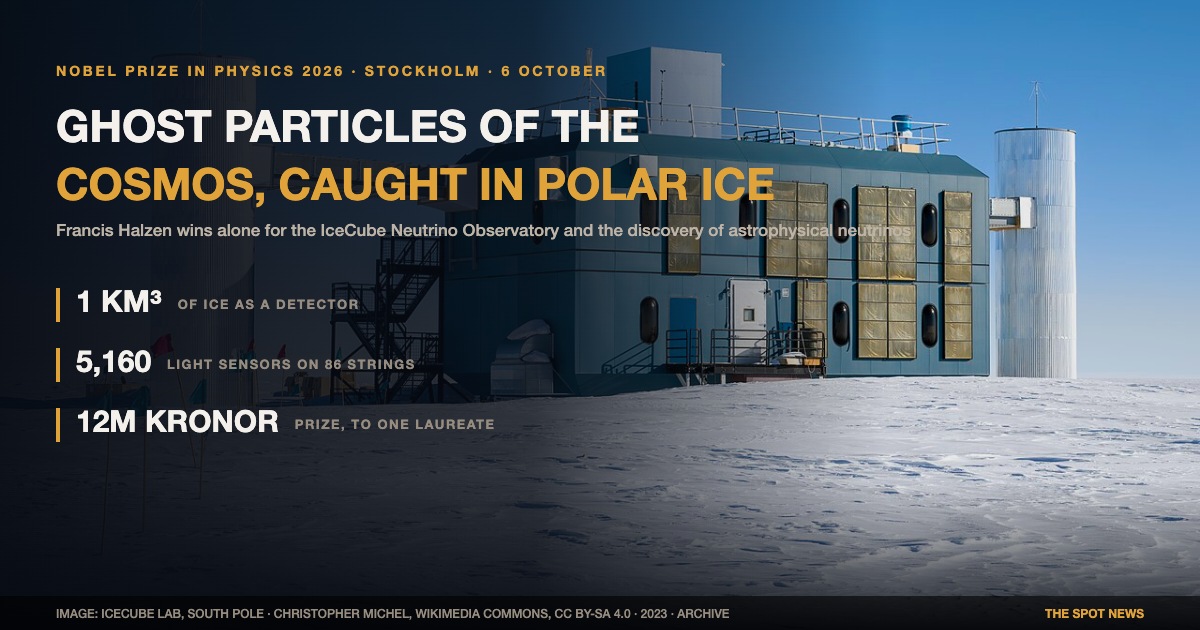
The Royal Swedish Academy of Sciences awarded the 2026 Nobel Prize in Physics on Tuesday 6 October to Francis Halzen of the University of Wisconsin-Madison for decisive contributions to the IceCube Neutrino Observatory and the discovery of high-energy neutrinos of astrophysical origin. Announced in Stockholm by the academy’s secretary general, Ellen Moons, the prize is worth 12 million Swedish kronor (about $1.2 million) and this year goes to a single laureate.
Neutrinos are among the most abundant particles in the universe, yet they interact so rarely with matter that they are known as ghost particles; trillions pass through the human body every second. Halzen’s idea was to use the pure, dark glacial ice at the South Pole as a giant detector. Built between 2005 and 2010, IceCube consists of 5,160 light sensors on 86 strings lowered to depths of 1,450 to 2,450 metres, capturing the faint blue light produced by rare neutrino collisions in the ice. The instrumented volume is one cubic kilometre.
In 2013 IceCube detected high-energy neutrinos from beyond the Solar System for the first time; in 2017 it traced a neutrino to a blazar galaxy about 4 billion light years away, helping to launch multi-messenger astronomy. Mark Pearce, chair of the Nobel Committee for Physics, said Halzen had led an international team of researchers and engineers who provided a fantastic instrument, and that his tenacity and scientific vision had paved the way for a new kind of astronomy. According to the academy, the neutrino interactions IceCube continuously collects will provide new knowledge about the violent settings in which high-energy neutrinos are created and could even reveal previously unknown cosmic phenomena.
Born in Tienen, Belgium, in 1944, Halzen earned his PhD at KU Leuven in 1969 and has worked at Wisconsin-Madison since 1972. The award is the second in physics to honour the leader of a major international observatory since the 2017 prize to Rainer Weiss, Barry Barish and Kip Thorne for gravitational waves, and the first unshared physics prize since then. Nobel week continues with chemistry on Wednesday, literature on Thursday, peace on Friday and economics on 12 October.
The award to Francis Halzen on 6 October 2026, the citation, Wisconsin-Madison, Pearce's remarks and the 'unknown cosmic phenomena' line: Nobel Foundation press release, 6 October 2026. The 1944 Tienen birth, the 1969 Leuven PhD, the cubic kilometre of ice and 'new type of astronomy': Nobel Foundation popular science background, 6 October 2026. Ellen Moons's announcement: nobelprize.org home page, 6 October 2026. The 12 million kronor and about $1.2 million: Al Jazeera and NBC (Reuters), 5 October 2026. The 86 strings, 5,160 sensors, 1,450 to 2,450 metre depths, 2005 to 2010 construction, the 2013 detection and the 2017 blazar: Wikipedia, IceCube Neutrino Observatory. The 2017 gravitational wave prize: Wikipedia, list of Nobel laureates in physics. The week's schedule: Nobel Foundation announcement dates page.
Halzen's age is calculated from his birth year (82). The 'trillions per second' statement is general physics knowledge. The claim that this is the first unshared physics prize since 2017 is derived from the Nobel list, as the 2018 to 2025 prizes were shared.
Halzen's first reaction, IceCube's planned expansion (IceCube-Gen2) and the details of the 2013 discovery cited in the award are not covered here.
Leave a comment