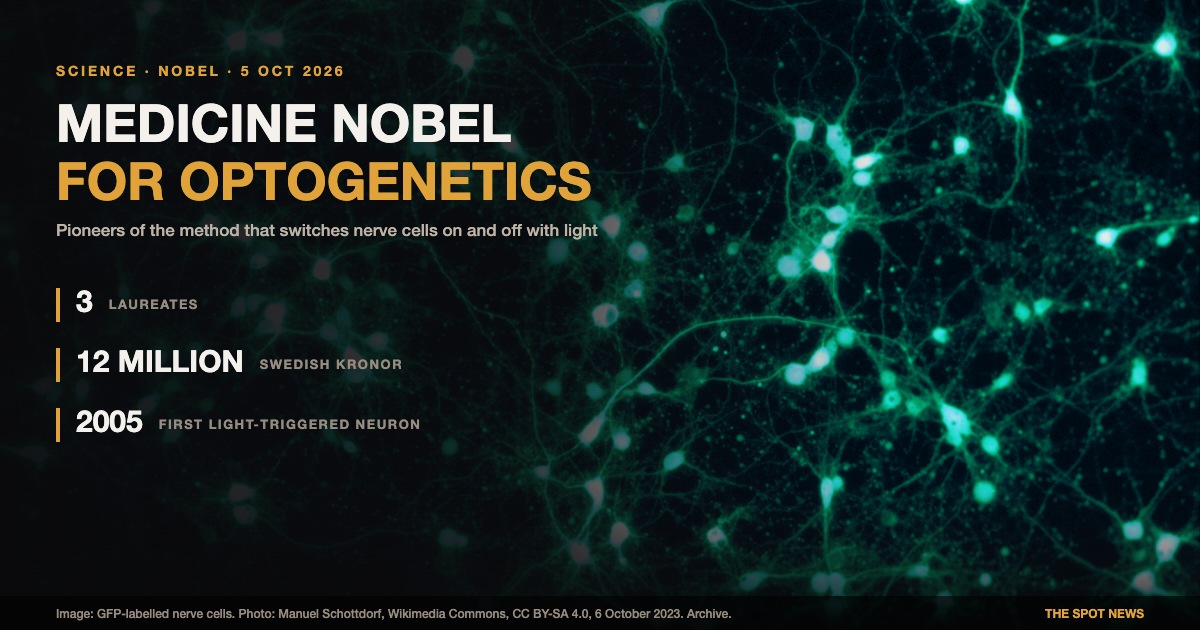
The Nobel Assembly at Karolinska Institutet awarded the 2026 Nobel Prize in Physiology or Medicine on 5 October to Karl Deisseroth, Peter Hegemann and Georg Nagel. The prize recognises the discovery of light-gated ion channels and the method that grew out of it, optogenetics. Optogenetics makes it possible to switch the activity of individual nerve cells in a living brain on and off with light.
Hegemann and Nagel discovered a protein called channelrhodopsin in a single-celled green alga that moves towards light; any cell carrying the protein became sensitive to light. In 2005 Deisseroth, of Stanford University, introduced the channelrhodopsin gene into rat nerve cells and triggered a nerve signal with blue light; he later made this light-controlled switch work in the brains of living mice.
Per Svenningsson, chair of the Nobel Committee, said optogenetics offers a way of mapping the brain that researchers could once only dream of. The method is now used in laboratories worldwide to study how memories, feelings and behaviour arise in the brain.
The prize money of 12 million Swedish kronor will be shared equally among the three scientists. As every year, the medicine prize opened Nobel week; the physics, chemistry, literature, peace and economics prizes will be announced in the coming days.
The laureates, citation, 12 million kronor prize and Svenningsson's remark were confirmed through the NobelPrize.org press release; details of the method through Scientific American, NBC News (Reuters), the University of Würzburg and the Jeantet Foundation.
Ernst Bamberg, Ed Boyden and Gero Miesenböck, who shared earlier major prizes for optogenetics, are not among this year's Nobel laureates; the Nobel Committee's detailed reasoning is set out in its public scientific background document.
The current status of clinical trials using the method directly to treat people is not covered in this story.
Leave a comment