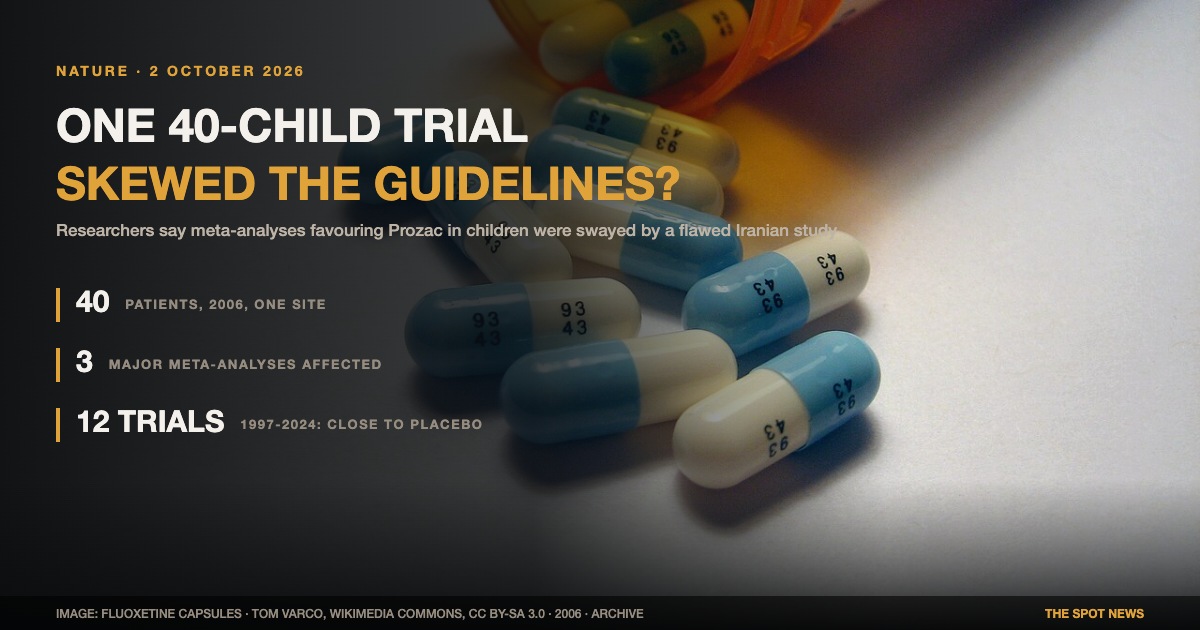
According to a Nature news report published on 2 October, a group of researchers argue that a single small clinical trial of 40 children in Iran, published in 2006, may have wrongly swayed medical evidence in favour of using Prozac (fluoxetine) to treat depression in children and adolescents. Fluoxetine is the only antidepressant approved for childhood depression and is recommended as the first-line drug in guidelines from several major medical organisations.
In a re-appraisal posted on medRxiv, the researchers note that three influential network meta-analyses of treatments for paediatric depression gave conflicting results on fluoxetine versus placebo: two published in The Lancet were favourable, while a 2021 Cochrane analysis concluded the effect was no longer clinically meaningful. They traced the discrepancy to a single-site Iranian trial of 40 patients comparing fluoxetine with another drug, nortriptyline, without a placebo arm, which reported an unusually large effect favouring fluoxetine. Removing that one trial reconciled the Lancet analyses with Cochrane’s result. The case, they say, shows how a single small problematic trial can substantially distort the clinically important findings of network meta-analyses.
The finding is the latest in an accumulating body of work. A separate meta-analysis by the same team covering 12 trials from 1997 to 2024 found that fluoxetine offered no clinically meaningful benefit over placebo in children, with early and more positive trials showing a novelty bias. A meta-regression published this year in the Journal of Psychiatric Research found the decline in efficacy could not be explained by age, baseline severity or added psychological interventions, and that an older single-centre trial at high risk of bias was driving the results. The researchers argue that side effects such as weight gain and sleep and concentration problems may outweigh a minimal benefit, and that guidelines should be reassessed.
This report is not treatment advice. The researchers’ objection is that the evidence base supporting fluoxetine in children may be weaker than assumed; no patient taking the drug should stop without consulting their doctor, since abruptly discontinuing antidepressants carries its own risks. The response of guideline bodies to these findings does not appear in the sources.
Nature's report of 2 October 2026, the single 2006 trial of 40 children in Iran and the claim that it swayed meta-analyses: Nature (via CSNSF and Lemmy), 2 October 2026. The three network meta-analyses, the Lancet and Cochrane discrepancy, the nortriptyline comparison, the absence of a placebo arm, the single site and the reconciliation after removal: the researchers' medRxiv preprint, September 2025. The 12-trial meta-analysis, the near-placebo finding, novelty bias and the side-effect assessment: Plöderl et al., Journal of Clinical Epidemiology, 2025 (via S4ME and the Guardian). The meta-regression findings: Journal of Psychiatric Research, 2026. Fluoxetine's approval status and guideline position: Wikipedia, fluoxetine; Mad in America, September 2026.
The full text of Nature's report could not be accessed; this report relies on its summary and the researchers' own publications. The re-appraisal is a preprint and it is not clear from the sources whether it has been peer-reviewed. The researchers' findings are contested within the medical community, and guideline bodies' responses are unknown. Nothing in this report constitutes treatment advice.
The response of the Iranian trial's authors, the reaction of guideline bodies such as NICE and the American Academy of Child and Adolescent Psychiatry, and data on fluoxetine use in children in Turkey are not covered here.
Leave a comment