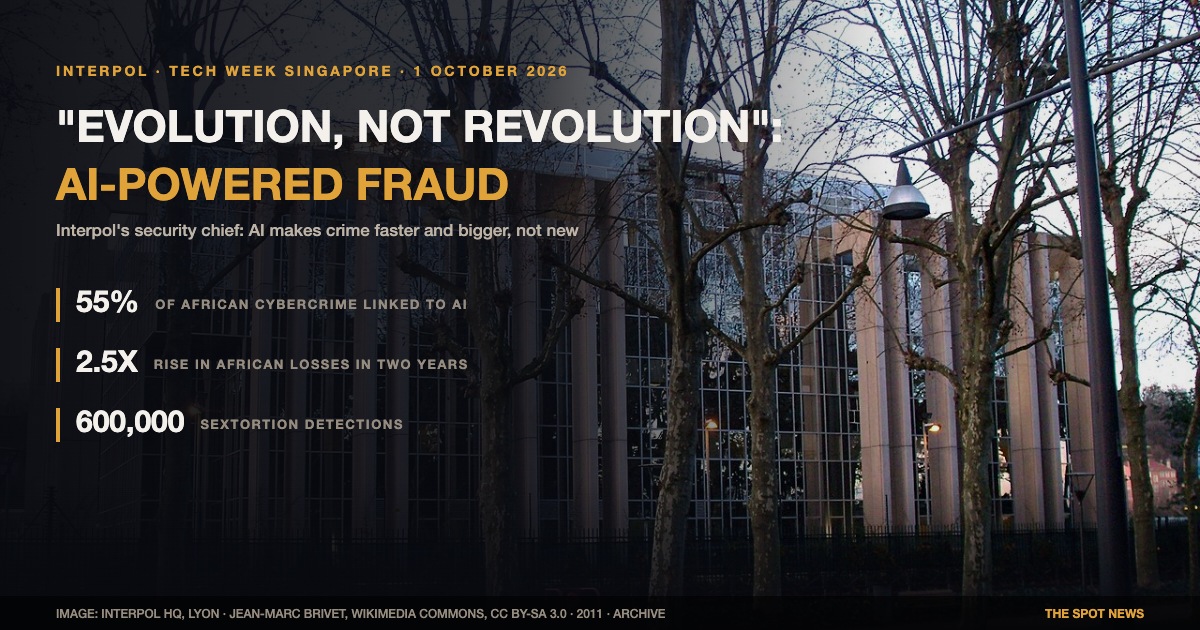
Interpol’s global chief information security officer, Bjorn R. Watne, says artificial intelligence is not transforming cybercrime but is accelerating and scaling existing techniques such as scams and fraud. Speaking to CNBC on the sidelines of Tech Week Singapore on Thursday 1 October, Watne described the shift as an evolution and not a revolution, with AI primarily increasing the speed and scale of established methods.
According to Watne, AI lets scam operators target many victims simultaneously, while improved translation and convincing digital identities make fraudulent interactions increasingly hard to distinguish from real ones. Interpol’s African Cyberthreat Assessment Report 2026 paints the same picture: AI is enabling 55% of reported cybercrimes across the continent, making attacks faster, more scalable and harder for victims and platforms to detect. The report, based on survey data from 36 countries, found online scams remained the most reported type of cybercrime, while digital sextortion and online harassment, often facilitated by AI-generated deepfakes and synthetic media, remained pervasive; one Interpol partner recorded about 600,000 sextortion detections. Cybercrime-related financial losses on the continent rose from $192 million to $484 million in two years, a 2.5-fold increase.
Watne singled out agentic AI, systems able to take actions on a user’s behalf, as a distinct concern. There is a difference, he said, between an AI feeding you the wrong information and one that acts, since the latter can create consequences beyond bad advice; he pointed to AI in cars and self-driving vehicles, where an erroneous action could have physical consequences. As AI systems become more capable of acting for users, he said that level of trust warrants greater scrutiny.
His advice to businesses is to identify their most valuable assets, their crown jewels, and tailor security to real threats. Although cyber risk is moving up corporate risk registers, he said it has yet to fully reach the boardroom at many companies, and some industries have not recognised how dependent their operations are on technology. He warned against blindly trusting new technology, saying AI deserves the same caution people apply to banking PINs. Interpol’s report calls for investment in AI literacy among police, standardised digital forensics capacity and cross-border cooperation.
Watne's CNBC interview at Tech Week Singapore on 1 October 2026, the 'evolution and not a revolution' and 'speed and scale' remarks, targeting many victims, translation and digital identities, agentic AI and the car example, and the risk register and boardroom assessment: National Technology, 2 October 2026; US News Beep (citing CNBC), 2 October 2026. The crown jewels advice and the PIN analogy: NewsBytes, 2 October 2026. The 55% figure, 36 countries, the most reported crime type, deepfake-enabled sextortion, 600,000 detections and the AI literacy call: Interpol press release, August 2026. The rise from $192 million to $484 million: Streamlinefeed (citing the Interpol report), 2 October 2026. Context on the report: SolidAITech, 1 October 2026.
The 55% and loss figures rest on survey data for Africa only; they are not global rates. The 600,000 sextortion detections come from one Interpol partner. Some outlets reported Watne as saying attacks have become impossible to detect; that wording does not appear in the primary account of the interview and is not used here.
Turkey-specific data, Interpol's global loss estimate and details of concrete measures against AI-enabled fraud were not provided.
Leave a comment