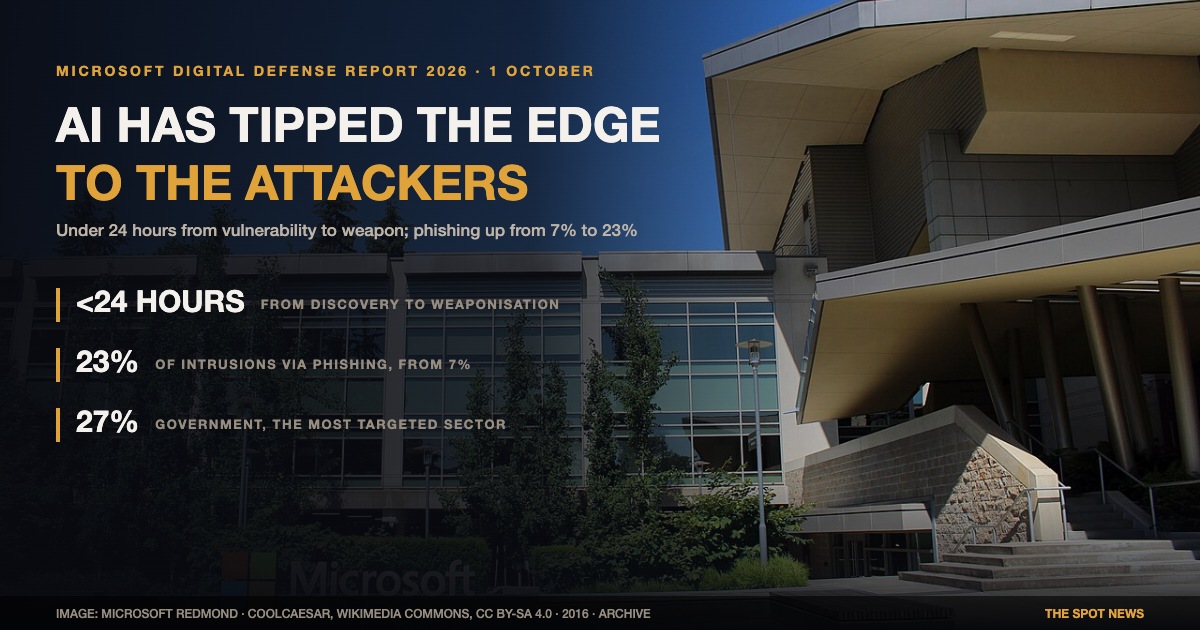
Microsoft published its 2026 Digital Defense Report on 1 October, drawing on 165 trillion daily security signals. Covering July 2025 to June 2026, the report concludes that AI has shifted the near-term advantage to attackers. While the equilibrium between attackers and defenders will likely be re-established eventually, Microsoft said, in the near term attackers are reaching the advantages first and defenders will need to move sharply to close the gap.
The report shows every stage of an attack accelerating. Vulnerability discovery and exploitation, which once required human experts, now in many cases comes down to simply writing a prompt, Microsoft said; the median time from a vulnerability’s discovery in the wild to its weaponisation has dropped to well below 24 hours. The number of vulnerabilities tracked for 2026 is on track for a record of about 72,000. For sophisticated actors, Microsoft says, AI reduces the attack chain from days to seconds; for less skilled actors, it makes available the scale and persistence that was once the sole domain of intelligence agencies. After a compromise, data exfiltration, credential discovery and lateral movement have shrunk from days to minutes.
Phishing is back. In intrusions investigated by Microsoft’s incident responders, phishing was the initial access vector in 23% of cases, up from 7% a year earlier. Exploits against public-facing applications rose from 15% to 24%. AI lets attackers personalise every phishing message, turning spear phishing into a mass operation and removing language barriers. Adversary-in-the-middle kits now make up 44.6% of identified phishing techniques; these pages steal live sessions rather than passwords, defeating SMS or app-based two-factor authentication. Among intrusions involving compromised accounts, 52.2% led to further credential theft.
Government was the most targeted sector, accounting for 27% of observed threat activity, up from 17% the previous year, and governments are also the most frequent targets of nation-state actors. Microsoft’s Australia and New Zealand national security officer, Mark Anderson, said that a year ago the conversation about AI and cybersecurity was about what might happen, and that this year’s data shows those theoretical risks have become reality. Microsoft’s recommendations: phishing-resistant multi-factor authentication such as hardware keys or passkeys, strict access controls and AI in defence. The warning applies directly to Turkey, where personal data leaks and phishing are widespread.
The report period, 'simply writing a prompt', under 24 hours, 72,000 vulnerabilities, phishing rising from 7% to 23%, public-facing exploits from 15% to 24% and personalisation: Help Net Security, 2 October 2026. Government's 27% share (17% last year), nation-state targeting and 52.2% credential theft: Microsoft On the Issues blog, 1 October 2026. The 165 trillion signals, the three trends, Anderson's remarks and the phishing-resistant MFA recommendation: Geekzone, 2 October 2026. 'Attackers reaching advantages first' and 'days to seconds': BleepingComputer, 2 October 2026. Post-compromise timelines shrinking to minutes: SC World, 3 October 2026. The 44.6% AiTM, 33.6% URL and 12.9% attachment shares and the 1 October publication: DEV Community analysis, 3 October 2026.
The data reflect Microsoft's own customer base and incident response cases and may not represent the whole internet. Part of the rise in phishing may reflect better visibility, as the share of cases with no identified entry point fell from 25% to 14%, according to the DEV Community analysis. The report contains no Turkey-specific data.
The report's findings for Turkey and the region, the list of most targeted countries and ransomware statistics are not covered here.
Leave a comment