What does the post claim?
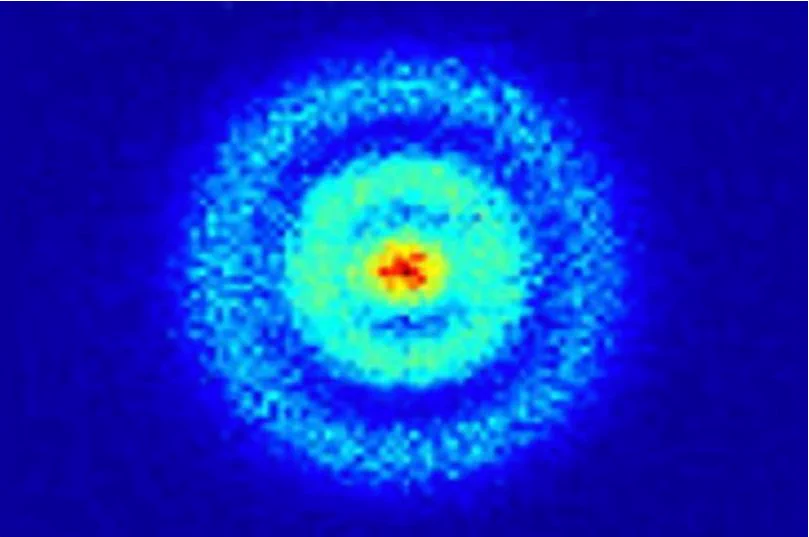
The @dr_logvinovich account on X proposes an “IT³” model in which the vacuum has a discrete geometric structure and electromagnetic energy could be confined within it, forming mass through vibration. The post explains the idea with a computer simulation and two images placed side by side, presenting their visual similarity as support for the model.
But two images looking alike does not prove that they show the same physical mechanism. A simulation visualizes a model’s assumptions; by itself, it is not experimental evidence that the proposed mechanism occurs in nature.
How does established physics explain mass?
CERN’s explanation of particle physics says interactions with the Higgs field play a role in giving fundamental particles such as electrons and quarks their masses. Most of the mass of protons and neutrons comes from the energy of the strong interaction that binds their constituent quarks together.
The relationship between energy and mass is well established in physics. That general relationship, however, does not by itself prove that atoms are “trapped light.” For this particular model to gain acceptance, its calculations would need to be transparent and reproducible, and its measurable predictions tested independently.
A prediction is not a discovery
The post says the model predicts a new particle resonance at about 1,088 GeV and that the periodic table should end at element 172. These are predictions the model presents as testable; the post does not report an observation of that resonance or experimental confirmation of an element limit.
The post links to the author’s preprints and code on Zenodo. Posting a preprint or saying that a manuscript has been submitted to a journal does not mean the results have passed peer review or been experimentally confirmed. The claims should therefore be treated as a proposal awaiting independent scrutiny, not as an established scientific result.
Sources
- 23 September 2026 post from the @dr_logvinovich account on X
- Zenodo preprint linked in the post
- Second Zenodo record linked in the post
- CERN: The Higgs field and the mass of fundamental particles
- CERN: Where most of the mass of protons and neutrons comes from
The @dr_logvinovich post on X, dated September 23, 2026, the model name ("IT³"), the linked Zenodo preprints, and CERN's explanations of the Higgs field/strong interaction are all directly sourced and verifiable.
The model's predicted ~1.088 GeV resonance and its claimed boundary at element 172 have not been experimentally confirmed; Zenodo is a preprint server, not a peer-reviewed venue.
Whether the model's calculations have been reviewed by independent physicists is not stated; the poster's academic background/credentials are not verified in this article.