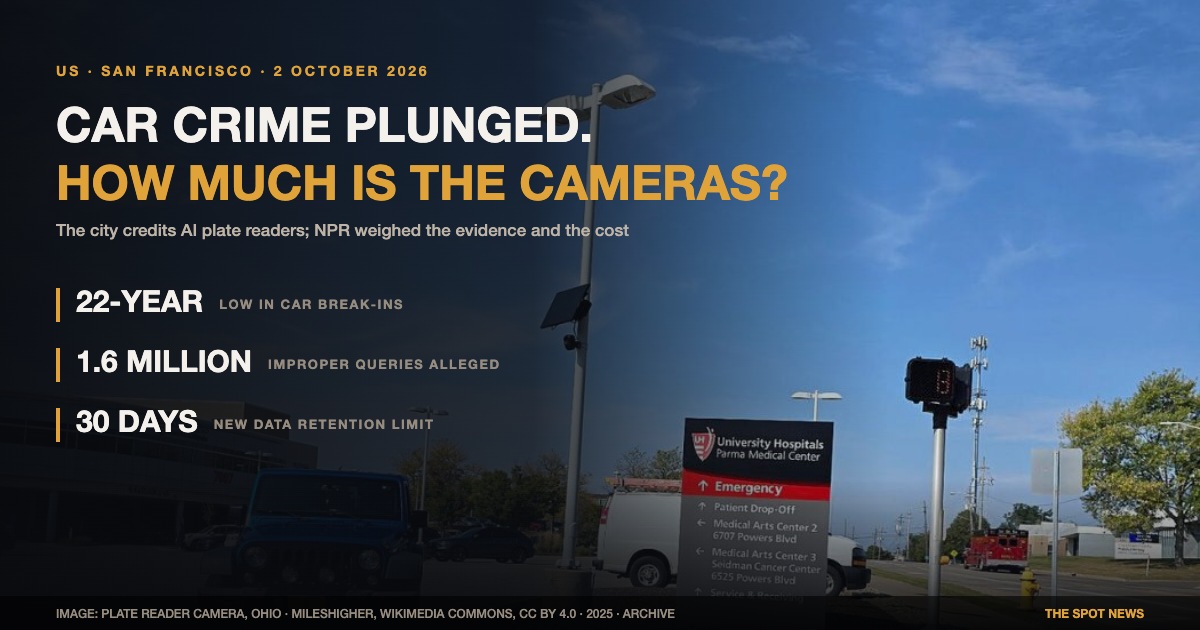
Car break-ins, for years a symbol of San Francisco, are at a 22-year low according to the city, and the homicide rate is the lowest since 1954. City leaders say AI-powered licence plate reader cameras from Flock Safety deserve a significant share of the credit. The cameras’ software identifies not only plates but a car’s make, colour, body style, roof racks and bumper stickers; District Attorney Brooke Jenkins says the cameras work together with drones to catch suspects without dangerous police chases, and create an evidence trail for prosecution.
NPR’s Planet Money examined the claim on 2 October. The decline is real, it found, but how much is down to the cameras is unclear. In the same period the city got a new district attorney, police increased patrols and began using drones, and the drop coincided with a broader post-pandemic fall in crime across American cities. Researchers compared data from 216 law enforcement agencies that introduced Flock cameras with places that had not; car theft fell more sharply where Flock was adopted, suggesting the finding is not merely a general decline. A University of South Carolina criminology study also found plate readers reduced vehicle thefts by 11%. But NPR notes that break-ins in San Francisco fell even more sharply than thefts, and that a community-built map of camera locations shows large gaps in residential areas where many break-ins happen; individual arrest videos do not prove a citywide plunge.
The cost is also contested. In June, San Francisco police revealed that plate reader data had been improperly accessed hundreds of times by out-of-state and federal agencies; one technology outlet puts the number of improper queries at 1.6 million. In April, a San Jose police officer was fired for using the technology to track a civilian who had accused his family member of domestic violence. Several California communities have cancelled Flock contracts.
Mayor Daniel Lurie announced new rules on 29 September: Flock must remove plate data from its systems after 30 days, the data will then be solely under police control, and officers’ searches must be justified and reported. Previously Flock had access to the data for 12 months. Lurie said the city does not willingly share the data with federal agencies and will pursue state legislation penalising officers who misuse it. Flock itself cut its default retention to seven days in August, meaning the city’s new rule remains looser than the company’s own standard. The company says it will automatically suspend users whose search activity looks abnormal.
The features Flock's software identifies, Jenkins's remarks on drones and chases, the 216-agency comparison, the new district attorney, patrols, drones and the broader crime decline, break-ins falling faster than thefts, the gaps in the community map, the limits of individual videos and Flock's automatic suspension plan: NPR Planet Money, 2 October 2026 (via IJPR and WFSU). Break-ins at a 22-year low, homicides lowest since 1954, Lurie's 30-day rule, Flock's previous 12-month access and the rules not needing board approval: SF Standard, 29 September 2026. The improper access revealed in June, the justification requirement, the federal sharing statement, the state legislation effort and the San Jose firing: KQED, 30 September 2026. The University of South Carolina 11% finding and local cancellations: Spectrum News, 30 September 2026. The 1.6 million improper queries, Flock's seven-day retention and the city's rule being looser than the company's: TechTimes, 29 September 2026.
The cameras' share of the decline has not been precisely measured; NPR's analysis shows several possible causes. The 1.6 million figure comes from a single source (TechTimes); the police department's own statement refers to hundreds of accesses. Who conducted the 216-agency analysis is not stated in NPR's account.
The number of cameras in San Francisco, their cost, a full breakdown of who made the improper queries and how the new rules will be audited have not been disclosed.
Leave a comment